
As you explore the promising world of psychedelic healing, the MAPS Canada Youtube channel and podcast is your resource for science-based information, learning, and invigorating conversation. Whether you're a researcher, a healthcare professional, or simply someone who wants to learn more about psychedelics, check out the MAPS Canada YouTube channel and podcast.
Our YouTube:
Includes MAPS Canada’s Podcast and all video content. Subscribe to the YouTube channel today!
MAPS Canada Podcast:
The MAPS Canada Podcast hosts a variety of guests from scientists on the cutting edge to popular figures sharing personal experiences, to policy makers discussing the present and future legal landscape of psychedelics. By bringing together such a broad range of voices, the MAPS Canada podcast provides listeners with a multi-dimensional view of the psychedelic movement in Canada and around the world.
The MAPS Canada podcast is a video podcast, but it’s also available in audio-only format on Amazon and Spotify. Whether you are a long-time enthusiast or new to the world of psychedelics, the MAPS Canada podcast has something to offer for everyone. So don’t miss out!
2026 PODCAST VIDEOS
October 9, 2026
MAPS Canada presents:
The Relational Nature of Psychedelics: Indigenous Knowledge & Healing with Dr. Keith Williams
Healing is often understood through the individual experience, but what might we learn by centring Indigenous perspectives on the deeply relational nature of psychedelic healing?
In this episode of the MAPS Canada Podcast, host Matt Hamel speaks with Dr. Keith Williams, an associate professor at Athabasca University and psychedelic researcher with training in psychedelic-assisted therapy. Dr. Williams has worked with Indigenous and local communities across Canada and around the world on plant-related projects, with a particular focus on the traditional uses of food and medicine plants.
The conversation explores on a paper Dr. Williams co-authored in the Journal of Psychedelic Studies, exploring inner healing intelligence through the lenses of critical vitalism and Indigenous thought. Dr. Williams lives in Mi’kma’ki (Nova Scotia) and has paternal family roots from a Mohawk (Haudenosaunee) community on the northern shores of Lake Ontario. Although he does not identify as Indigenous, Dr. Williams draws on Indigenous thought, traditional botanical knowledge, and his own experiences working with communities and the land. He explains how psychedelic-assisted therapy might be understood through a more relational and place-based framework.
Dr. Williams also discusses the risks of extracting or appropriating Indigenous practices and knowledge into Western psychedelic therapy, and why Indigenous knowledge should instead be recognized on its own terms and treated as a philosophical and epistemological partner. He considers what it might look like for practitioners to establish deeper relationships with the medicines, lands, and communities where they live, rather than simply incorporating isolated elements of Indigenous traditions into existing therapeutic models. Dr. Williams also shares his vision for a future of psychedelic-assisted therapy that embraces multiple ways of knowing while fostering reciprocity, connection, and a deeper sense of place.
To access the paper discussed in this episode, visit: https://www.akjournals.com/view/journals/2054/10/1/article-p59.xml
If you would like to connect with Dr. Keith Williams, he can be reached at: kwilliams@athabascau.ca
September 25, 2026
MAPS Canada presents:
Access to Psychedelic Care in Indigenous Communities with Dr. Leah Mayo
August 28, 2026
MAPS Canada presents:
Rethinking Psychedelic Access in Canada with TheraPsil CEO Spencer Hawkswell
What happens when psychedelic research moves beyond the traditional pharmaceutical model and becomes more patient-centred, grassroots, and responsive to the realities of how people are actually accessing these therapies?
In this episode of the podcast, host and MAPS Canada Executive Director Dr. Rielle Capler speaks with Spencer Hawkswell, CEO and President of TheraPsil, about the evolving landscape of psychedelic research, access, and policy in Canada. Spencer discusses innovative approaches to clinical research, including a participant-funded psilocybin trial focused on wellness, group-based treatment models, and the potential to develop more accessible research pathways for psychedelic therapies. They also explore the challenges created by conventional clinical-trial models and the importance of generating evidence that reflects the needs and experiences of patients.
The conversation also examines the realities of psychedelic access outside formal legal pathways, the role of professional training and harm reduction, and the potential for observational and qualitative research to better understand how Canadians are using psychedelics in the real world. Rielle and Spencer discuss psychedelic-assisted approaches to end-of-life distress, the relationship between psilocybin and MAID, and the role of patient advocacy, public education, and policy reform in shaping the future of psychedelic access in Canada. Together, they consider how research, clinical practice, and grassroots advocacy can work alongside one another to build safer and more accessible pathways to psychedelic care.
August 21, 2026
MAPS Canada presents:
Bringing Psychedelic Research to the Rave with Rachel Simon
What can we learn about psychedelics by studying how people actually use them in the real world?
In this episode of the MAPS Canada Podcast, host Matt Hamel speaks with psychedelic researcher and MAPS Canada volunteer Rachel Simon about her research investigating psychedelic use in music festival and rave environments.
Rachel recently completed her Master’s of Science in Psychology at McMaster University, where her research explored the mechanisms underlying long-term change following psychedelic experiences. After encountering challenges recruiting participants through clinical settings, Rachel began asking a different question: why not conduct psychedelic research where people are actually using psychedelics?
This led to a naturalistic, longitudinal research initiative taking place at music festivals across Canada, including Shambhala Music Festival in British Columbia and VELD in Toronto. Rachel also shares some of the creative approaches she has taken to recruiting participants, including using QR codes on bracelets and festival totems, and explains how being a festival attendee herself helped her develop a more natural and authentic approach to engaging participants.
The conversation also looks toward the future of naturalistic psychedelic research, including Rachel’s vision for developing dedicated research hubs at music festivals and expanding the study of psychedelic use beyond the traditional clinical setting.
To connect with Rachel or to learn more about her research, Rachel can be reached on LinkedIn and via email: simonr1@mcmaster.ca
July 31, 2026
MAPS Canada presents:
Eating Disorders, Psychedelics and Targeting Cognitive Rigidity with Shel Scott
In this episode of the MAPS Canada Podcast, host Matt Hamel speaks with occupational therapist Shel Scott about the emerging role of psychedelic-assisted therapy in the treatment of eating disorders. Drawing from her unique perspective as both an eating disorder survivor and a mental health clinician, Shel explores why eating disorders remain among the most challenging psychiatric conditions to treat, and where psychedelic medicines may offer new therapeutic possibilities. Beyond the clinical discussion, Shel shares her own recovery journey and reflects on how lived experience shapes her therapeutic approach. The episode also explores Shel’s work in psychedelic policy and research through MAPS Canada’s EXPAND Study, highlighting ongoing efforts to improve access to evidence-based psychedelic therapies through Canada’s Special Access Program. To learn more about Shel’s clinical practice, visit Prevailing minds.
Learn more about MAPS Canada’s Community of Practice (CoP) & learn more about MAPS Canada’s research initiatives, such as the EXPAND Study.
July 24, 2026
MAPS Canada presents:
The Medicine Within | Ep. 7: Entropy, Plasticity & the Critical Window Period with Dr. Manesh Girn
In this final episode of the Medicine Within series, neuroscientist Dr. Manesh Girn (The Psychedelic Scientist) joins us to unpack what happens in the brain after a psychedelic experience. Together, we explore:
- What actually happens in the brain after a psychedelic journey
- Neuroplasticity and how psychedelics support lasting change
- The science of entropy and altered states of consciousness
- The “critical window” after a psychedelic experience—and why it matters
- Whether different psychedelics create different windows for change
- Why it’s not just serotonergic psychedelics that can enhance neuroplasticity
- Whether cannabis is a psychedelic
July 1, 2026
MAPS Canada presents:
From Idea to Action: Shawn Shabaquay’s Run for MMIWG and Psychedelic Research
In this episode of the MAPS Canada Podcast, host and MAPS Canada’s Executive Director Dr. Rielle Capler speaks with Shawn Shabaquay from Wabigoon Lake Ojibway Nation in Ontario about his personal journey of transformation, resilience, and purpose.
Shawn discusses his 40 km run from Dryden to Wabigoon Lake Ojibway Nation on July 1, 2026, held to honour his mother and in support of Missing and Murdered Indigenous Women and Girls (MMIWG). It is also part of a GoFundMe fundraiser for psychedelic research and MAPS Canada.
The conversation also explores Shawn’s relationship with ceremony, psychedelics, and personal healing, including experiences with peyote in ceremonial contexts and psilocybin experiences that informed his understanding of grief, trauma, and personal growth.
He speaks openly about his personal experiences that have shaped his commitment to healing and community work. This episode contains discussions of sensitive topics. Please listen with care and prioritize your well-being.
To contribute to Shawn’s GoFundMe, visit https://www.gofundme.com/f/A-Run-For-MMIW-July-1-2026
To check out Shawn’s YouTube channel, visit https://www.youtube.com/shorts/MTzTggENnOk
June 26, 2026
MAPS Canada presents:
Psychedelics, Cannabis, and Brain Health Research in Canada with Crystal Phillips
In this episode of the MAPS Canada Podcast, host Matt Hamel speaks with Crystal Phillips, co-founder of the Branch Out Neurological Foundation, about the evolving landscape of brain health research and the role of innovative, non-pharmaceutical approaches to neurological disorders.
The conversation explores Branch Out’s funding of psychedelic and cannabinoid research, including studies on ibogaine for addiction and cannabis-based investigations into neuroinflammation, sleep, stroke recovery, and the endocannabinoid system. Crystal emphasizes the importance of building a rigorous evidence base for emerging therapies so that clinicians and patients can make informed decisions grounded in science.
Crystal shares the personal story that led her to create Branch Out after an early, aggressive diagnosis of multiple sclerosis transformed her life and career as an elite speed skater. What began as a deeply personal journey navigating conventional and alternative healthcare systems eventually evolved into a national funding organization dedicated to advancing neuroscience research across Canada.
The episode also highlights Branch Out’s broader commitment to holistic brain health, including prevention, precision medicine, optimization, and emerging fields such as longevity and brain health monitoring. Crystal speaks to the importance of exploring all viable avenues for improving neurological outcomes while maintaining scientific rigor and balance.
To learn more about Branch Out Neurological Foundation, current funding opportunities, or to support their work, click here.
June 19, 2026
MAPS Canada presents:
What Happens in the Brain During a Psychedelic Experience? | with Dr. Manesh Girn
In this episode of the MAPS Canada Podcast, host Sonia Brodie speaks with neuroscientist Dr. Manesh Girn about the emerging science of how psychedelics influence the brain and why these experiences may create opportunities for lasting psychological change.
Drawing from his recent large-scale neuroimaging research, Dr. Girn explains how scientists are beginning to identify common patterns of brain activity across different psychedelic substances.
The conversation explores what these findings reveal about consciousness, perception, and the ways psychedelics may temporarily alter communication between brain networks that are typically kept separate.
The discussion also examines the growing evidence for psychedelic-induced neuroplasticity, including the concept of critical periods — windows of heightened adaptability that may persist after a psychedelic experience.
Dr. Girn shares why preparation, integration, and intentional behavior change may play an important role in translating these biological effects into meaningful long-term outcomes.
Beyond mental health applications, the episode explores emerging research into neuroplastogens, non-hallucinogenic compounds inspired by psychedelics that may promote neuroplasticity without producing altered states of consciousness. The conversation highlights how these compounds could potentially contribute to future treatments for neurodegenerative and inflammatory conditions, opening new directions for psychedelic-inspired medicine.
Together, the discussion offers an accessible look at the neuroscience behind psychedelics and the rapidly evolving research that is reshaping our understanding of the brain’s capacity for change.

June 13, 2026
MAPS Canada presents:
Why Older Adults Are Turning to Psychedelic Therapy with Scott Paul Wright
In this episode of the MAPS Canada Podcast, host Matt Hamel speaks with filmmaker Scott Paul Wright about his documentary The Next Chapter, an intimate and deeply human exploration of adults over the age of 55 who are turning to psychedelic-assisted therapy as a pathway to healing, meaning-making, and renewal.
The film follows individuals navigating depression, anxiety, grief, trauma, and existential questions later in life, often after conventional treatments have not provided sufficient relief. Through their stories, The Next Chapter highlights both the challenges and the possibilities of psychedelic-assisted therapy, while centering the importance of integration, human connection, and hope.
Scott also shares his own personal journey into this work, including his experience with psilocybin at age 68, and how that experience shaped his decision to create the film. What emerges is a reflection on vulnerability, transformation, and the shared human search for meaning.
The upcoming world premiere of The Next Chapter takes place on June 18, 2026 at The Royal Cinema in Toronto, followed by a live Q&A panel featuring the filmmaker alongside leading clinicians, researchers, and voices in Canada’s psychedelic medicine community, including Dr. Joshua Rosenblat and Dr. Blake Pearson. The event is designed as a community gathering and conversation, bridging lived experience with clinical and research perspectives at a time when psychedelic-assisted therapy is rapidly entering the public discourse in Canada. For more information about the documentary and how you can attend, visit https://thenextchapterfilm.com/
May 29, 2026
MAPS Canada presents:
CAN-PACT: Reimagining Cancer Care Through Psychedelic Therapy with Dr. Ron Shore & Dr. Linda Carlson
In this episode of the MAPS Canada Podcast, host Matt Hamel speaks with Dr. Linda Carlson and Dr. Ron Shore about CAN-PACT (the Canadian Network for Psychedelic-Assisted Cancer Therapy), a groundbreaking national initiative exploring the role of psilocybin-assisted therapy for people living with advanced cancer.
Dr. Carlson and Dr. Shore discuss the emotional and existential challenges many cancer patients face, including anxiety, uncertainty, grief, demoralization, and fear surrounding death and dying. They explain how CAN-PACT is building a cross-Canada network of researchers, clinicians, patient partners, and educators to investigate how psychedelic-assisted therapy may help address these deeply human experiences.
The conversation explores:
• Existential distress and demoralization in cancer care • Group-based psilocybin-assisted therapy
• Mindfulness and psychedelic-assisted therapy
• The role of spirituality, meaning, and connection
• Training clinicians for future psychedelic-assisted care
• The future of psychedelic-assisted therapy in Canada The episode also examines how CAN-PACT hopes to create sustainable, evidence-based models that could eventually be integrated into mainstream cancer care across Canada.
Learn more about CAN-PACT: https://canpact.ca
Watch the MAPS Canada Research Room presentation featuring CAN-PACT
May 22, 2026
MAPS Canada presents:
How Psilocybin Changed One Man’s Experience with Terminal Cancer | with Steve Allgood
In this episode of the MAPS Canada Podcast, host Rielle Capler speaks with Steve Allgood about his experience navigating a terminal brain cancer diagnosis and the unexpected role psychedelics played in helping him confront fear, depression, and existential distress.
Steve shares the emotional reality of being diagnosed with terminal brain cancer just days before his wedding, the difficult process of radiation treatment, and the psychological toll of living under the belief that his life would soon end. The conversation explores his search for hope through alternative approaches to care, including high-dose cannabis and psilocybin mushrooms, and how these experiences gradually transformed his relationship to illness, suffering, and meaning.
The discussion also highlights the importance of emotional support, psychedelic safety, and reducing stigma around end-of-life care and alternative therapies. Through Steve’s deeply personal story, the episode offers insight into the growing conversation surrounding psychedelics, mental health, and quality of life for individuals facing serious illness.
May 14, 2026
MAPS Canada presents:
The Medicine Within | Ep. 5: Navigating the Psychedelic Experience with Ryan Schebek
In Episode 5 of Medicine Within, Osheen sits down with registered clinical counsellor Ryan Schebek to explore the realities of navigating the ketamine experience — from dissociation and preparation to breathwork, resistance, and integration.
Together, they unpack:  Whether ketamine is truly a psychedelic Why “set and setting” matter so deeply How healing can still happen through challenging experiences The importance of realistic expectations and ethical therapeutic support
“Healing is not always comfortable, but it can still be transformative.”
For more on Ryan and his work, check out:
Ryan Schebek LinkedIn
https://www.layers-counselling.ca www.instagram.com/ryan.schebek.therapy
April 30, 2026
MAPS Canada presents:
The Medicine Within | Episode 4: Myths, Risks & Neuropharmacology of Psychedelics
Are psychedelics the “miracle cure” often portrayed in the media, or is the reality more nuanced?
- Women’s Health: Gaps in psychedelics research regarding hormonal fluctuations and chronic pain.
- Harm Reduction: Why “more” isn’t better and the reality of conditions like Serotonin Syndrome.
- The “One and Done” Myth: Why integration and community support are essential for lasting change.
April 24, 2026
MAPS Canada presents:
Inside Psychedelic Public Education at MAPS Canada with Dr. Rielle Capler
March 27, 2026
MAPS Canada presents:
What has LSD Research Taught us About Treating Alcohol use Disorder?
In this episode of the MAPS Canada Podcast, host Matt Hamel speaks with Dr. Erika Dyck about the remarkable early wave of psychedelic research conducted in Saskatchewan during the 1950s and 1960s.
Researchers based in the Canadian prairies, including Humphry Osmond, developed an ambitious program investigating the potential of LSD as a treatment for alcoholism. During this period, Osmond also famously coined the term “psychedelic” in correspondence with Aldous Huxley, helping shape the language that still defines the field today.
Dr. Dyck explores the broader scientific and cultural context that allowed this pioneering research to flourish. The conversation also examines the social and political forces that abruptly halted this early wave of work, and how the insights from this era of Canadian research continues to influence today’s renewed interest in psychedelic science, including modern studies on psychedelics and alcohol use disorder.
March 20, 2026
MAPS Canada presents:
Can Psychedelics Heal the Roots of Addiction? with Dr. Pamela Kryskow
March 13, 2026
MAPS Canada presents:
The Medicine Within | Ep. 3: Preparing for the Journey: Intention, Set & Setting with Raman Samra
In Episode 3 of Our Medicine Within Series, host Osheen Dayal is in conversation with Raman Samra, a clinical counsellor and art therapist with over a decade of experience working in the correctional system and private practice, now serving as a psychedelic-assisted therapist in clinical trials.
Topics of discussion include:
Why intention matters When and how to set it
How to prepare the day before The importance of mindset, space, and context
Finding the right guide, therapist, or sitter
Safety, support, and ethical facilitation
Preparation isn’t optional — it’s part of the medicine.
March 3, 2026
MAPS Canada presents:
Remembering Who We Are: Wellness, Culture & Sacred Connection with Francine Douglas
In this episode of the MAPS Canada Podcast, host Rielle Capler sits down with Francine Douglas to explore the theme of wellness and connection through a deeply personal, cultural, and systemic lens.
Drawing from her experience as a First Nations woman, counsellor, and co-founder of Sacred Circle Wellness, Francine reflects on the medicine wheel and the interconnection of physical, emotional, mental, and spiritual health. She shares how sacred medicines offered a reminder to a return to balance, self-care, cultural practice, and belonging. This conversation moves beyond individual wellness into collective healing — examining how relationship, reciprocity, and cultural remembrance are essential foundations for true wellbeing.
For more on Francine and Sacred Circle, visit:
February 20, 2026
MAPS Canada presents:
The Medicine Within | Ep. 2: Breath as Medicine: Healing Without Psychedelics with Krystal Charlotte
February 13, 2026
MAPS Canada presents:
Ketamine & Connection: Love, Sex, Psychedelics & the Self with Angela Ivy Leong
January 30, 2026
MAPS Canada presents:
Vilca Afterglow: How Psychedelic Beer Shaped the Wari Empire with Justin Jennings
January 23, 2026
MAPS Canada presents:
Ayahuasca, Shamanism and the Religious Exemption That Never Was with Allan Finney
January 14, 2026
MAPS Canada presents:
Denied Psilocybin, Approved for MAiD: A Doctor’s Fight for Common Sense
In this episode of the MAPS Canada podcast, policy and advocacy team member Kyle Sittek-Lumsden speaks with Dr. Blake Pearson about his father Pete Pearson’s experience with existential distress as well as the application process for psychedelic-assisted therapy and medical assistance in dying. They talk about the personal difficulties related to a terminal diagnosis and how Pete’s SAP application was denied after an 11 month waiting period while his MAiD request was accepted within 30 days. Join us for this moving and emotional discussion on how these two policy issues intersect in a real-world case. If you would like to show support for Pete’s case to receive compassionate access to psychedelic-assisted therapy through a section 56. exemption, please email the Minister of Health.
January 12, 2026
MAPS Canada presents:
Exploring Hidden Paths of Mental Health Using Ibogaine with Jonathan Dickinson, Ambio Life Sciences
What happens when an ancient plant medicine meets cutting‑edge neuroscience and careful clinical protocols?
This episode of the MAPS Canada podcast traces Ibogaine’s path from traditional Tabernanth iboga ceremonies to medically supervised treatment for people navigating addiction, PTSD, and other mental health challenges.
Jonathan Dickinson, Chief Executive Officer and Co-Founder of Ambio Life Sciences and podcast host Osheen Dayal talk about cardiac safety, exclusion criteria, neuroplasticity, and how community, culture, and integration shape the long‑term impact of the experience.
January 12, 2026
MAPS Canada presents:
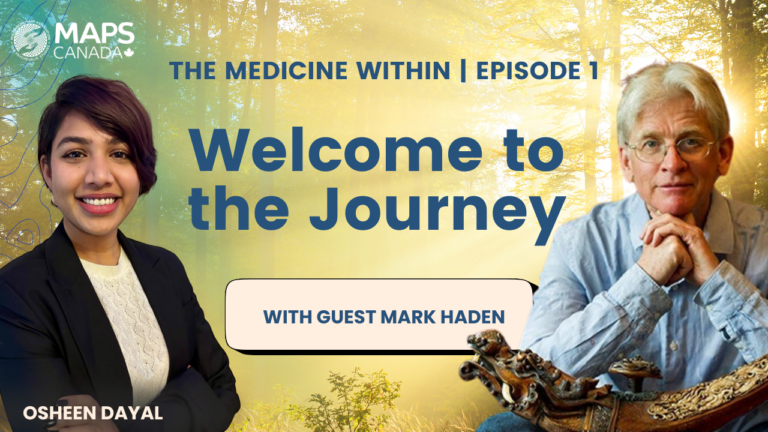
The Medicine Within | Ep. 1: Reframing Psychedelics—Healing, Risk & Responsibility with Mark Haden
The Medicine Within is a 7-part MAPS Canada series hosted by Osheen Dayal, exploring the evolving landscape of psychedelic medicine, mental health, and embodied healing. Through grounded conversations with experts, practitioners, and voices of lived experience, this series explores how inner healing is cultivated through intention, integration, community, and care — beyond substances alone.
In the opening episode of The Medicine Within, Mark Haden joins Osheen Dayal for a wide-ranging conversation on psychedelics — from shifting drug policy and public perception to neuroplasticity, intention setting, community use, and integration. Together, they unpack common myths, real risks, and the broader cultural and environmental implications of psychedelic healing, while emphasizing responsibility, preparation, and advocacy.