
Interested in learning from Canadian researchers at the forefront of psychedelic science? Consider this your invitation to join the Research Room, our monthly online expert-led series. Register for free today!
The MAPS Canada Research Room is a monthly webinar series dedicated to showcasing cutting-edge Canadian research across diverse disciplines within the burgeoning field of psychedelic studies. Our mission is to democratize access to psychedelic science, and fostering inclusivity through knowledge translation and dissemination of academic knowledge in a more accessible manner.
Each research room session is an hour long, and provides researchers a platform through which they can dynamically engage with the audience about their current research.
Interested in presenting or would like to see someone present? Click here for to sign up.
For more information email us at: researchroom@mapscanada.org
- Meetings are held on Zoom
- One Thursday, every month, 7 PM ET (4 PM PT) (see note)
- Anyone with an interest in psychedelic science and research, anywhere in the world, is welcome to attend.
UPCOMING SESSIONS
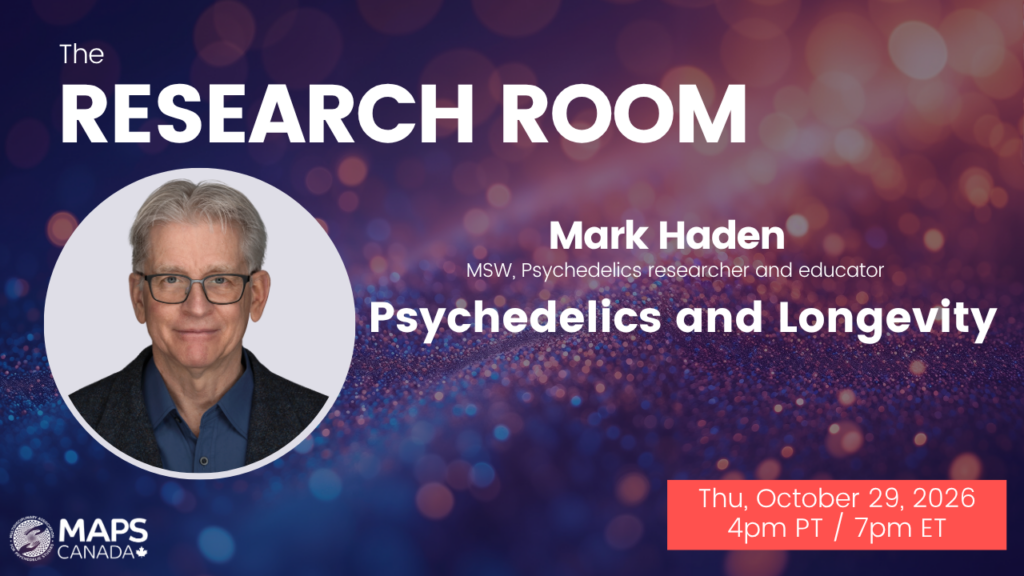
October 29, 2026
MAPS Canada Research Room presents:
Psychedelics and Longevity
Speaker Bio—Mark Haden is a leader in the field of psychedelic medicines, with a long list of past and present activities and responsibilities. Among—and beyond—these, he served as the Executive Director for MAPS Canada for 10 years and was an Adjunct Professor at the University of British Columbia School of Population and Public Health. He was the Clinical Supervisor for the psychedelic treatment program at Qi Integrated Health and is the vice president of business development at Clearmind Medicine. He is an instructor, teaching psychedelic therapy with the ATMA program, and has written a book, the Manual for Psychedelic Guides (now in its third edition), which makes this information widely available.
Mark has published numerous articles in respected journals, has presented at conferences and training events in many countries, and was awarded the Queen’s Diamond Jubilee Medal in 2013 for drug policy reform work. Mark also has a well-deserved reputation as an exciting speaker who never fails to engage and surprise audiences. You can read his latest publications and listen to his presentations here: www.markhaden.com
Talk Abstract: Was it just a coincidence that Albert Hoffman – who invented LSD – and strongly believed in macrodosing – lived to be 102?
Longevity science has increasingly shifted its focus from extending lifespan to improving healthspan, the years lived in good physical, cognitive, and social health. While much research targets biological hallmarks of aging, emerging frameworks emphasize upstream psychosocial drivers such as chronic stress, trauma, social isolation, and health behavior. In parallel, research on psychedelic compounds (e.g., psilocybin, LSD, MDMA, and ayahuasca) suggests they can produce durable changes in mental health, behavior, and social functioning, with downstream physiological implications. Multiple mechanisms implicated in psychedelic effects, (e.g.,enhanced neuroplasticity, modulation of immune and inflammatory signaling, stress-response recalibration, and sustained improvements in psychological well-being and social connectedness) overlap with pathways influencing biological aging.
This narrative review examines the convergence of psychedelic research and longevity science, exploring how psychedelic-assisted interventions may influence aging trajectories through both direct biological and indirect psychosocial pathways. We also discuss safety issues and research priorities, including integrating biomarkers, functional outcomes, and longitudinal study designs, and consider whether psychedelic interventions may function as systems-level catalysts for healthier aging.
PAST SESSIONS
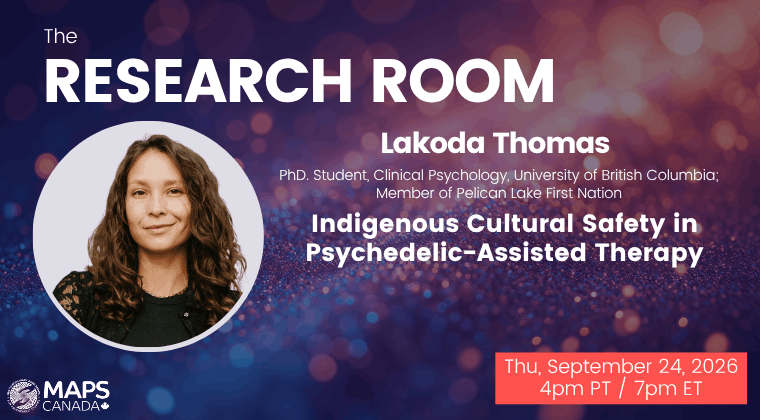
September 24, 2026
MAPS Canada Research Room presents:
Indigenous Cultural Safety in Psychedelic-Assisted Therapy
Speaker Bio—Lakoda Thomas is a PhD student in the Clinical Psychology program at the University of British Columbia Okanagan. She is of Plains Cree and Ukrainian settler ancestry. Her ancestral lands are on Treaty 6 Territory, and she is a member of the Pelican Lake First Nation. Lakoda obtained her BSc (Hons) and MA from the University of British Columbia; she is supervised by Dr. Zach Walsh. The qualitative research conducted for her MA thesis identified factors that may be vital to enhance the safety of psychedelic assisted therapy for Indigenous populations. Lakoda’s work aims to harmonize clinical and Indigenous models of health to optimize therapeutic interventions for Indigenous and non-Indigenous clients alike.
Talk Abstract:
Indigenous Peoples in North America face distinct barriers to accessing mental health care, including psychedelic assisted therapy (PAT). Although PAT has demonstrated efficacy for treatment-resistant mental health disorders, limited diversity in psychedelic research and the importance of set and setting highlight the need for Indigenous cultural safety (ICS), an approach to care that is respectful, culturally responsive, and reduces the incidence of racism and discrimination. However, to date, factors that promote ICS in PAT have not been systematically examined.
Using a qualitative design informed by postcolonial theory and Two-Eyed Seeing, 10 semi-structured interviews were conducted with experts in Indigenous mental health and psychedelic therapy. Data were analyzed using reflexive thematic analysis within a dual epistemological framework integrating constructivism and critical realism.
Four interconnected themes described the conditions required to support ICS in PAT across foundational, conceptual, applied, and structural levels.
The themes include: 1) Contextualizing Cultural Safety
2) Conceptualizing Culturally Aligned Psychedelic Care
3) Co-creating Culturally Aligned Psychedelic Care
4) Systemic Factors Impacting Accessibility
Findings suggest that achieving ICS in PAT requires a broader model of culturally aligned psychedelic care that builds upon the foundational principles of ICS, while remaining sufficiently flexible to address the unique therapeutic context of PAT. The project speaks to the conditions that are required for psychedelic care to become culturally aligned, ethically governed, and genuinely accessible for Indigenous communities. Culturally aligned psychedelic care cannot be achieved through isolated cultural adaptations to existing PAT protocols; it requires changes at the interpersonal, therapeutic, conceptual, and systemic levels.
Ultimately, a culturally aligned psychedelic model will be grounded in the foundational safety elements of psychedelic care, while maintaining sufficient flexibility to be adaptable to the needs of diverse Indigenous individuals and communities.
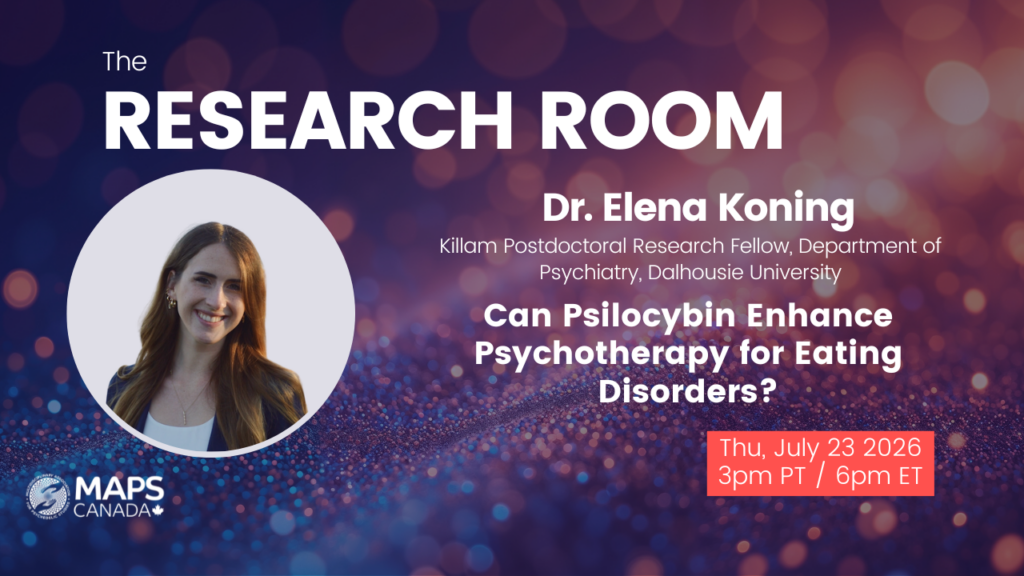
July 23, 2026
MAPS Canada Research Room presents:
Can Psilocybin Enhance Psychotherapy for Eating Disorders?
Speaker Bio – Dr. Elena Koning is a Killam Postdoctoral Research Fellow in the Department of Psychiatry at Dalhousie University and the Maritime Eating & Appearance Laboratory, and affiliate Research Scientist at the Centre for Psychedelics Health & Research (CPHR) at Queen’s University. Her research focuses on the therapeutic potential of psilocybin treatment as an adjunct to evidence-based psychotherapy for eating disorders, as well as incorporating study design adaptations, phenomenological approaches, and lived experience perspectives. Dr. Koning has authored numerous peer-reviewed publications in psychedelic psychiatry, eating disorders, and translational neuroscience, and is actively involved in scientific knowledge translation as host of the CPHR podcast The Integration Session. Together, Dr. Koning aims to advance scientifically rigorous, patient-centered research on novel interventions for difficult-to-treat psychiatric conditions.
Talk Abstract:
Eating disorders (EDs) are severe and difficult-to-treat psychiatric illnesses, with high mortality rates, limited pharmacological options, and substantial dropout and relapse from the gold-standard treatment cognitive behavioural therapy (CBT-ED). Our research program investigates the therapeutic potential of psilocybin treatment to enhance CBT-ED by targeting key neurobiological and psychological barriers, including cognitive rigidity, comorbid psychopathology, and experiential avoidance. This talk will overview our recent perspective article which provides the first consolidation of evidence for psilocybin-enhanced CBT-ED, proposes a concurrent intervention protocol, and discusses clinical research considerations to empirically evaluate it. Further, it will discuss how phenomenological approaches are often overlooked in conventional psychedelic study design, but can deepen our understanding of the therapeutic potential of psychedelic experiences by examining key experiential domains (e.g., embodiment, selfhood, affectivity). Finally, this talk will discuss the development of a clinical trial design which aims to evaluate the feasibility of a randomized controlled trial examining psilocybin-enhanced CBT-ED for bulimia nervosa. Together, this research is expected to advance the treatment of EDs and, more broadly, the study of psychedelics as tools to enhance evidence-based psychotherapies for difficult-to-treat neuropsychiatric conditions.
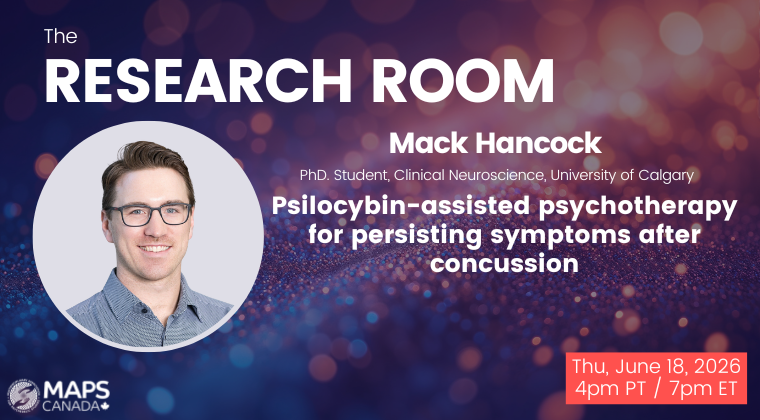
June 18, 2026
MAPS Canada Research Room presents:
Psilocybin-assisted psychotherapy for persisting symptoms after concussion
Speaker Bio – Mack Hancock is a PhD student in the Clinical Neuroscience program at the University of Calgary. Originally from Kingston, Ontario, Mack completed his undergraduate studies in Neuroscience at Dalhousie University. Currently, under the supervision of Dr. Chantel Debert, Mack is working on a clinical trial exploring the potential of psilocybin-assisted therapy for treating persisting symptoms after concussion, specifically examining the safety, feasibility, and efficacy of this intervention. In addition, he will be involved in a similar clinical trial investigating the same therapeutic approach for post-traumatic stress disorder in a population of intimate partner violence survivors.
Talk Abstract:
Persisting symptoms after concussion (PSaC) are experienced by up to a third of those who suffer a concussion. Symptoms can include headache, dizziness, fatigue, irritability, anxiety, impaired attention and memory, and noise and light sensitivity, which vary between patients and are often debilitating to day-to-day life. Unfortunately, there is no cure or evidence-based standard treatment these patients can turn to, as PSaC can vary for each patient. Current treatments, such as psychotherapy and pharmacotherapy, are not effective for all patients.
A novel treatment approach which has shown promise in treating similar symptoms as PSaC, such as cluster headaches, anxiety, and depression, is psychedelic-assisted psychotherapy. This therapy involves the therapeutic administration of a psychedelic substance, which is paired with psychotherapy before, during, and after medication administration.
This clinical trial aims to determine if psilocybin-assisted therapy is a safe, feasible, and effective intervention for adults with PSaC. Participants will be randomized to either a small control dose or a larger treatment dose of psilocybin, followed by 5 sessions of acceptance and commitment therapy adapted for patients with brain injury.
By measuring outcomes such as recruitment, adherence, safety, and preliminary efficacy in PSaC symptoms, this novel trial aims to identify the potential for psilocybin-assisted therapy to improve recovery for those suffering from PSaC.

May 14, 2026
MAPS Canada Research Room presents:
The Canadian Network for Psychedelic Assisted Cancer Therapy (CAN-PACT): Research Overview
Speaker Bio—Dr. Linda Carlson: Dr. Linda Carlson holds the Enbridge Research Chair in Psychosocial Oncology and is a Full Professor in the Department of Oncology, Cumming School of Medicine at the University of Calgary. She directs the Alberta Complementary Therapy and Integrative Oncology (ACTION) Centre and has provided clinical care at Cancer Care Alberta since 1997. A globally recognized leader in mindfulness-based cancer recovery and integrative oncology, Dr. Carlson has published over 250 peer-reviewed works, co-authored influential books, and received numerous prestigious awards, including the 2023 Dr. Rogers Prize in Complementary and Alternative Medicine. She also serves as Co-Editor-in-Chief of the Journal of Psychosocial Oncology Research and Practice, is Past-President of the Society for Integrative Oncology and Treasurer for the International Society for Contemplative Research.
Linda Carlson’s LinkedIn
Speaker Bio—Dr. Ron Shore: Dr. Ron Shore is a psychedelic scientist based out of Kingston Ontario and Co-Investigator of the Canadian Network for Psychedelic Assisted Cancer Therapy. Ron began his career as a community organizer at the height of the AIDS movement, helping start the Keep Six! Needle Exchange in 1991 and founding the Street Health Centre in 1996. Ron taught drug studies at Queen’s for 17 years and has taught in both the University of Ottawa psychedelics and consciousness program and in the UHN Foundations of Psychedelic Assisted Psychotherapy program.
Talk Abstract:
Background: Psychedelic-assisted therapy shows promise for psychological and existential distress in advanced cancer, with psilocybin producing rapid, sustained reductions in depression, anxiety, and demoralization. Mindfulness-based interventions, including MBCR, improve adaptation and quality of life. CAN-PACT integrates these approaches in a multi-site trial network.
Knowledge Gap: Prior trials have used individual dosing and have not integrated mindfulness-based oncology interventions. Evidence is limited for scalable, group-based models and optimizing shared mechanisms (e.g., relationality, meaning-making, attentional training).
Aim: To evaluate the feasibility, safety, and efficacy of a group-based psilocybin-assisted therapy model integrated with mindfulness-based care.
Methods: CAN-PACT is a multi-site Canadian trial soon to enroll patients with advanced cancer and demoralization. A factorial design compares 25 mg vs. 5 mg psilocybin (with supports), with and without adapted MBCR. Group dosing occurs within a shared therapeutic container. Outcomes include demoralization, existential well-being, biometrics, microbiome, safety, and feasibility.
Results: Study initiation is planned for fall 2026. Outcomes will assess acceptability, safety, and preliminary psychological improvement.
Conclusions: CAN-PACT advances a scalable model integrating psilocybin and mindfulness in a group format, informing future trials in psychosocial oncology and palliative care.
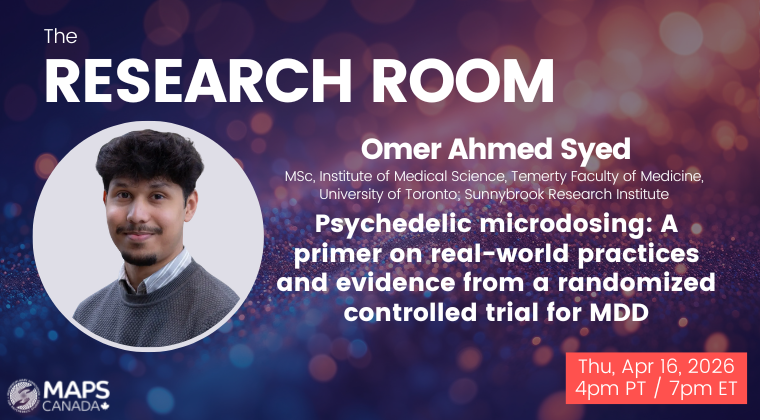
April 16, 2026
MAPS Canada Research Room presents:
Psychedelic microdosing: A primer on real-world practices and evidence from a randomized controlled trial for MDD
Talk Abstract:
Background: There is clinical interest in psychedelic microdosing and studying the practice in real-world settings can inform ecologically valid clinical study designs.
Aim: Provide an update on real-world microdosing practices using a recent global survey and share safety and efficacy results from a randomized controlled trial (RCT) on weekly psilocybin microdosing for Major Depressive Disorder (MDD).
Methods: The Global Psychedelic Survey 2025 was an online survey conducted in May 2025. The phase 2 RCT took place from July 2022 to December 2024. Participants were randomized 1:1 to first receive either 4 doses of double-blinded placebo or 4 doses of psilocybin. After the double-blind phase, all participants received 4 doses of open-label psilocybin. The primary outcome for depressive symptoms was change in the Patient Health Questionnaire-9 (PHQ-9) score.
Results: Across 5399 real-world consumers, psilocybin, LSD, and MDMA were most commonly microdosed. The ‘Fadiman protocol’ was the most endorsed dosing regimen. In the RCT, 39 participants with MDD first received either psilocybin (n=21) or placebo (n=18). There were significant reductions in PHQ-9 scores for both groups, and the difference between groups was not significant. There were no severe or serious treatment-emergent adverse events.
Conclusions: Microdosing is a popular practice. While safe and well tolerated, our trial found that weekly psilocybin microdosing was not more effective than placebo.
Omer Syed’s LinkedIn

March 19, 2026
MAPS Canada Research Room presents:
Psilocybin for comorbid Alcohol Use Disorder and Major Depressive Disorder: presentation of study protocol
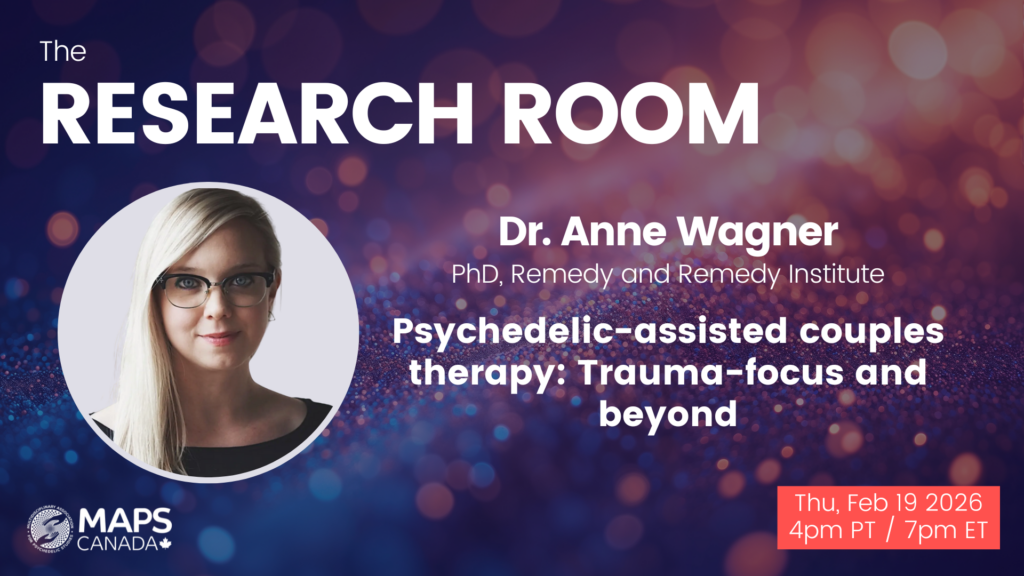
February 19, 2026
MAPS Canada Research Room presents:
Psychedelic-Assisted Couples Therapy: Trauma-focus and beyond
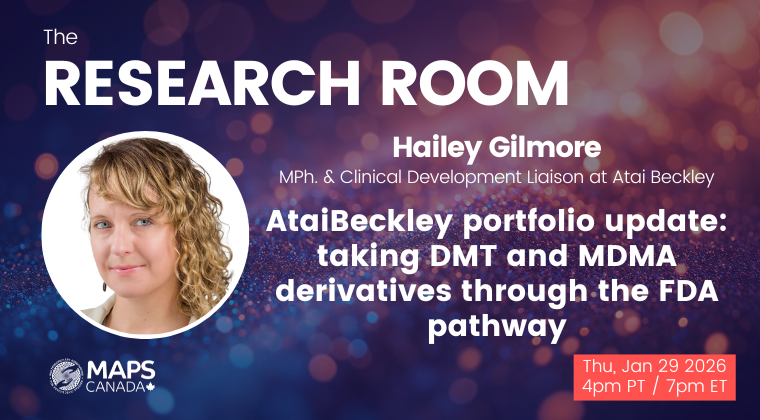
January 29, 2026
MAPS Canada Research Room presents:
AtaiBeckley portfolio update: taking DMT and MDMA derivatives through the FDA pathway
Speaker Bio: Hailey is a Master’s level biostatistician with over 16 years of experience in clinical research oversight. She has contributed to the lifecycle of more than 60 clinical trials, and is a co/author on 30+ publications and talks spanning several therapeutic areas. The nexus of health, justice, and impact is the ethos for the work she chooses. After spending 11 years managing NIH-funded HIV clinical trials in the U.S., South America, and Africa, including multiple regulatory approvals of drugs and devices, Hailey came to psychedelics. Since 2020 Hailey has worked at the intersection of Clin Ops and Med Affairs for MAPS PBC/Lykos Therapeutics, as a private consultant, and for AtaiBeckley, managing programs in the US, Canada, South America, Europe, and Australia. She was an SSDP Pipeline Mentor for 3 years, and her work has been featured on Psychedelic Alpha and The Trip Report podcast. Talk Abstract – AtaiBeckley is a clinical-stage biopharmaceutical company focused on developing innovative mental health treatments, primarily utilizing psychedelic compounds. Our pipeline targets conditions with significant unmet needs like treatment-resistant depression (TRD), social anxiety disorder (SAD), and alcohol use disorder (AUD).Key candidates include BPL-003 (intranasal 5-MeO-DMT), which has shown rapid and durable antidepressant effects in Phase 2a-b studies for TRD. VLS-01 (buccal film DMT) is in Phase 2 for TRD, targeting a short in-clinic treatment time and EMP-01 (oral R-MDMA) has completed a Phase 2 study for SAD.
Talk Abstract: AtaiBeckley is a clinical-stage biopharmaceutical company focused on developing innovative mental health treatments, primarily utilizing psychedelic compounds. Our pipeline targets conditions with significant unmet needs like treatment-resistant depression (TRD), social anxiety disorder (SAD), and alcohol use disorder (AUD).Key candidates include BPL-003 (intranasal 5-MeO-DMT), which has shown rapid and durable antidepressant effects in Phase 2a-b studies for TRD. VLS-01 (buccal film DMT) is in Phase 2 for TRD, targeting a short in-clinic treatment time and EMP-01 (oral R-MDMA) has completed a Phase 2 study for SAD.

Research Room Team

Aakanksha Sahu
Team Lead